Communication and language
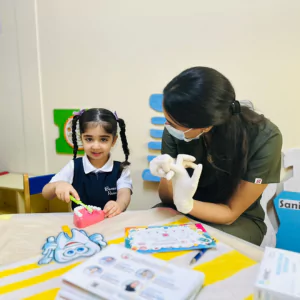
Talking, listening and being listened to. The single strongest predictor of how a child will do at school, which is why it runs through everything.
The EYFS is the framework used across British early years education for children from birth to five. It is not a syllabus and there is no textbook. It rests on a single idea: that very young children learn through play, repetition and exploration rather than instruction — and that an adult’s job is to notice, extend and gently steer rather than to deliver lessons.
In practice that means your child will spend the day playing. Our teachers spend the day watching closely, recording what they see, and setting up whatever comes next.
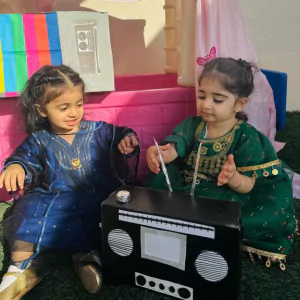
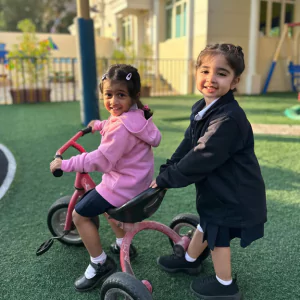
Three prime areas and four specific areas. The prime areas come first because the specific areas do not develop well without them. Your child will not experience any of this as separate subjects — a single morning of play can touch all seven.
Talking, listening and being listened to. The single strongest predictor of how a child will do at school, which is why it runs through everything.
Climbing, balancing, holding a pencil, managing a zip. Gross and fine motor skills, plus gymnastics and outdoor play each week.
Sharing, waiting, naming a feeling, recovering from a disappointment. The part parents notice first at home.
Stories, rhyme and the sounds inside words, well before any formal reading. Mark-making that becomes writing.
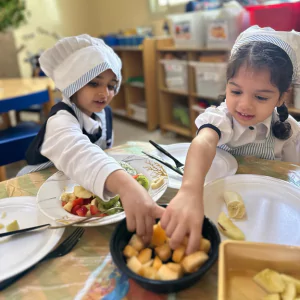
Counting, sorting, pattern, more and less, shape and space — mostly through handling real things rather than worksheets.
Families, places, living things, and how objects behave. In Sharjah that also means a room where many cultures sit side by side.
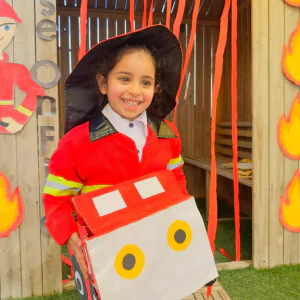
Paint, music, construction, role play. Where children try out ideas that have no right answer.
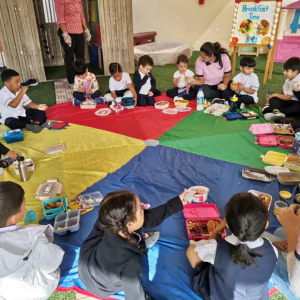
Most of the day is child-led. Children choose where to go and what to do, and the adults move between them — watching, narrating, asking a question and then waiting long enough to get an answer. That waiting is the skill.
Alongside that, each day holds focused adult-guided sessions: early language, early numbers, fine and gross motor work. These are short, because a two-year-old's attention is short, and they are pitched at the group in front of the teacher rather than at the age on the register.
Each week also includes gymnastics, music and outdoor play.
A two-year-old filling and emptying a jug is doing volume, cause and effect, and wrist control. Left alone, that is play. With a teacher who narrates it, asks a question and waits for the answer, it becomes learning.
The shape of a full day, Monday to Thursday. Friday finishes at midday.
Morning 7:00 – 10:15 AMMidday 10:45 AM – 2:00 PMAfternoon 2:00 – 5:30 PMThe British Early Years Foundation Stage, and only that. Plenty of nurseries in Sharjah advertise EYFS alongside Montessori and a STEM programme. One framework, with staff trained in it and assessment that genuinely follows it, is a different proposition from three at the surface.
The 3–4 year is the year before school, and it maps onto FS1 in the British curriculum schools most of our families go on to in Sharjah and Dubai. Children leave able to sit in a group, follow two-step instructions, hold a pencil properly and manage their own shoes and bag.
Children from 45 days to 4 years, in four class groups: Infant Class (45 days to 1 year), Toddler Class (1 to 2 years), Toddler Class 2 (2 to 3 years) and Preschooler Class (3 to 4 years). See the class groups.
A written note at pickup, every day — not a summary at the end of term. Beyond that: updates through the parent app, written progress reports, parent–teacher meetings and newsletters.
The best way to judge a curriculum is to watch it being taught. Come mid-morning, when the focused sessions are running.